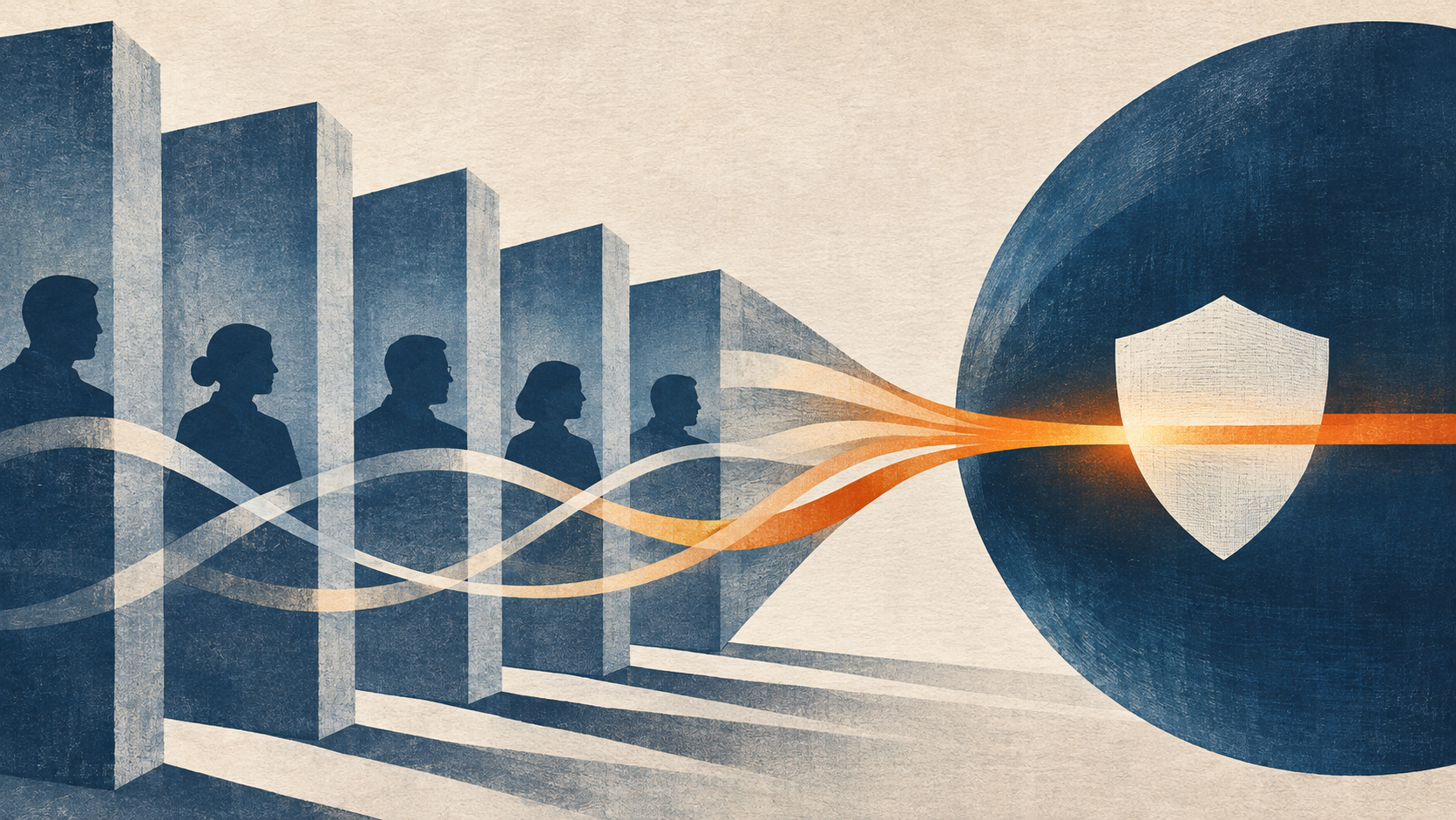
Why AI-driven vulnerability discovery demands a new C-suite approach to cyber resilience, governance, and trust infrastructure.
TL;DR | The Executive Takeaway
AI is dramatically accelerating vulnerability discovery and remediation development. But finding flaws faster doesn’t mean organizations can safely fix them, deploy changes, or sustain trust at scale.
The deeper bottleneck is organizational. Cyber risk, product security, IT, OT, cryptography, cloud, and now AI governance still operate in silos—even though vulnerabilities and trust failures cross every one of those boundaries.
The C-suite needs to rethink cybersecurity as Trust Lifecycle Management (TLM): connecting continuous cyber risk governance, identity, cryptographic infrastructure, operational enforcement, and AI control—from silicon and connected devices to enterprise, cloud, and autonomous AI.
The emerging measure of cyber resilience isn’t how fast we find vulnerabilities. It’s how fast we can safely remediate them, verify the outcome, and sustain trust.
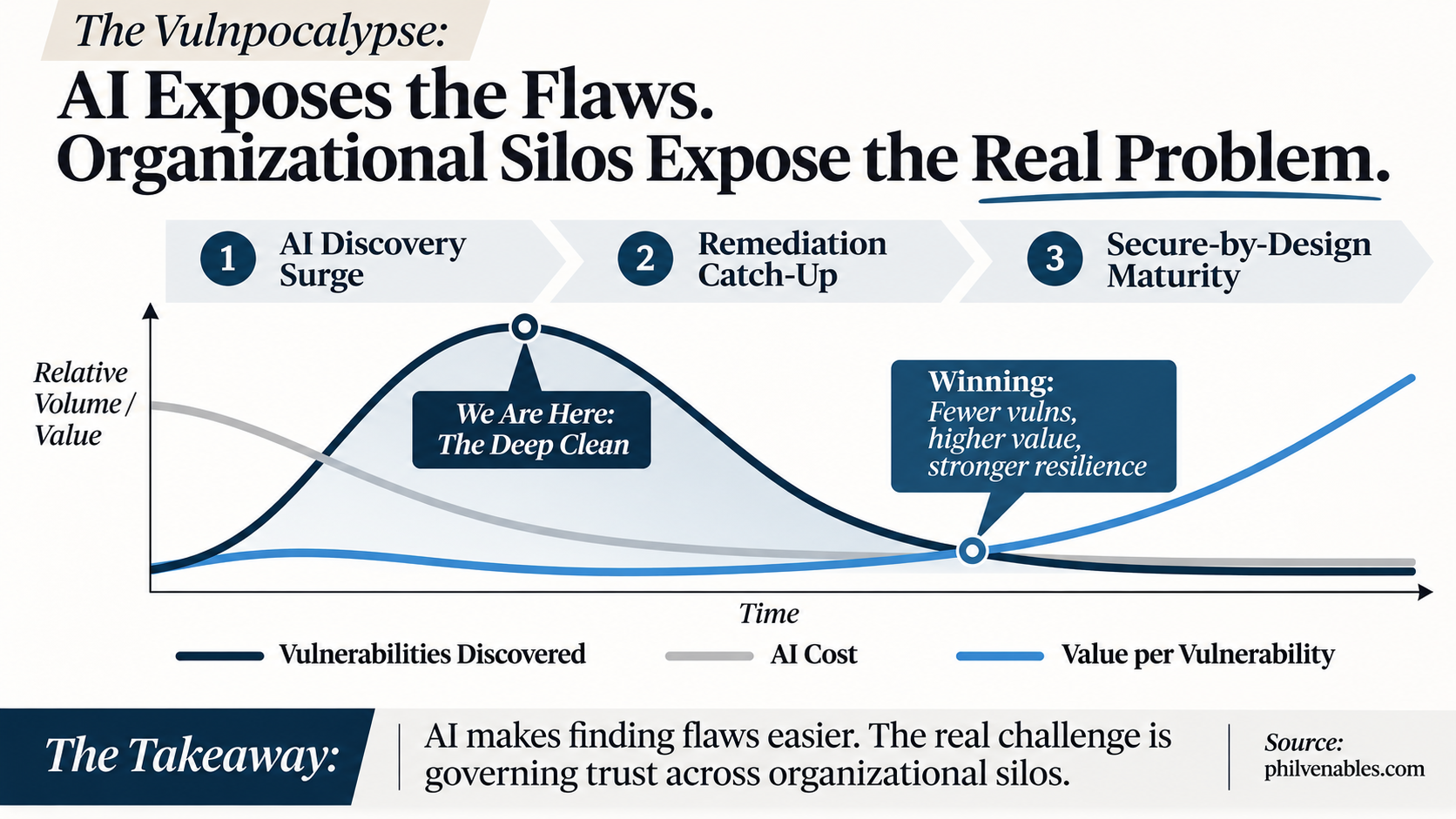
The Vulnpocalypse Is Exposing More Than Software Vulnerabilities
Phil Venables recently published an excellent piece, “The Vulnpocalypse – Good News and Bad News” (https://www.philvenables.com/post/the-vulnpocalypse-good-news-and-bad-news), examining how AI is reshaping the economics and operational realities of vulnerability discovery and remediation.
His central observation is compelling: AI is making it possible to discover vulnerabilities and develop fixes at unprecedented speed. But getting those fixes tested, approved, and safely deployed across complex operating environments remains a much harder problem.
The discovery problem is getting easier. The operational problem is not.
I believe there’s an even deeper issue beneath this dynamic: the way we’ve organized cybersecurity itself. For decades, enterprises have built security capabilities around separate technology domains, departments, budgets, and regulatory responsibilities.
Product security assesses risk. Engineering builds systems. IT secures infrastructure. PKI teams manage cryptographic trust. OT teams protect industrial environments. Compliance teams collect evidence. And now AI teams are rapidly introducing autonomous agents, models, and workflows.
Each discipline has legitimate responsibilities and specialized expertise. But vulnerabilities don’t respect organizational boundaries. Neither do cyberattacks.
And increasingly, neither does AI.
The Bottleneck Isn’t Just Remediation. It’s Coordination.
Consider what happens when a vulnerability is discovered in a connected product, industrial controller, medical device, cloud workload, or autonomous system. Someone must understand the exposure, evaluate the consequences, prioritize remediation, develop and test the fix, authorize deployment, securely distribute the change, and verify the outcome.
The software fix may take hours. The organizational and operational response can take months. A vulnerability discovered in one component may depend on hardware security, cryptographic credentials, software supply chains, manufacturing processes, deployment infrastructure, regulatory approvals, and operational teams distributed across multiple organizations.
Meanwhile, responsibility for assessing risk, approving changes, operating infrastructure, and maintaining compliance evidence may sit with entirely different departments.
The vulnerability belongs to a system. The responsibility for managing its consequences spans the enterprise.
That makes the Vulnpocalypse as much a governance and leadership challenge as a technical one.
Cyber Risk Governance Must Become Continuous
Traditional cyber governance, risk, and compliance (GRC) has too often revolved around periodic assessments, audit cycles, compliance milestones, and point-in-time evidence.
Those activities remain necessary. But they’re insufficient for systems that continuously change. New vulnerabilities emerge. Software evolves. Suppliers change. Cryptographic algorithms age. Cloud infrastructure expands. AI introduces new identities, permissions, and execution paths. An assessment completed six months ago may describe a system that no longer exists in the same form.
Cyber risk for connected systems is not a one-time project. It’s a lifecycle process.
The objective must shift from documenting risk at a particular moment to continuously understanding how risk changes—and connecting that intelligence to decisions, controls, remediation, and verifiable evidence. Governance without operational enforcement is incomplete. Enforcement without lifecycle governance lacks context and accountability.
That connection is becoming fundamental to cyber resilience.
Trust Starts at Silicon, Not at the Security Dashboard
The Vulnpocalypse becomes especially complicated when we move beyond enterprise software. Billions of connected devices, industrial systems, vehicles, medical technologies, semiconductor platforms, and extended Internet of Things (xIoT) environments operate under radically different constraints.
Many remain deployed for decades. Some cannot tolerate downtime. Others are disconnected, physically inaccessible, safety-critical, or subject to extensive validation requirements. In these environments, the ability to remediate vulnerabilities safely must be engineered into systems long before a vulnerability is discovered.
That means establishing trustworthy hardware identities, secure provisioning, firmware integrity, cryptographic roots of trust, software signing, and controlled update mechanisms from the beginning. And it means maintaining those controls across manufacturing, deployment, operations, updates, service, and retirement.
A vulnerability scanner can identify a problem. It cannot, by itself, establish that a replacement firmware image is authentic, an update is authorized, a device retains its trusted identity, or a safety-critical system remains operational.
The ability to remediate safely is an architectural capability—not something we can improvise after the vulnerability is discovered.
Enterprise, Cloud, and AI Extend the Same Trust Problem
The challenge doesn’t stop at connected devices.
Enterprise and cloud environments depend on an expanding universe of certificates, cryptographic keys, secrets, digital signatures, machine identities, workloads, and APIs. These form the underlying trust relationships that make modern digital infrastructure function. Yet they are often governed through fragmented tools, disconnected authorities, and separate operational teams.
Shorter certificate lifetimes, expanding machine identities, and post-quantum cryptographic migration only increase the need for coordinated lifecycle governance.
And now AI adds another dimension. Autonomous agents can access repositories, invoke tools, interact with enterprise applications, manipulate data, generate code, and potentially initiate changes to production environments.
An AI agent that recommends a security fix is one thing.
An AI agent authorized to modify code, operate credentials, or initiate deployment workflows is an entirely different trust challenge.
Who establishes its identity? Who grants its authority? What can it access? Which actions require approval? What policies are enforced during execution? What evidence remains afterward?
AI governance cannot stop at discovering AI usage or monitoring model behavior. It must extend to identity, permissions, data protection, tool access, runtime enforcement, and accountability. AI agents are becoming operational identities with real authority and real consequences. They must be governed accordingly.
The C-Suite Must Connect the Silos It Created
None of this suggests organizations should eliminate specialized security teams or centralize every technical decision.
It does suggest that trust must become a shared enterprise-wide responsibility, supported by connected governance and operational infrastructure.
CEOs, CIOs, CISOs, and CTOs need to think across the full digital trust chain:
-
Continuous Cyber GRC: Living risk assessments, control mapping, governance, reassessment, and audit evidence.
-
Silicon, embedded systems, and xIoT: Hardware-rooted identity, device integrity, secure provisioning, software supply-chain trust, and trusted updates.
-
Enterprise and cloud: Cryptographic lifecycle governance, trust authorities, machine identities, certificates, keys, secrets, and workload security.
-
AI and autonomous systems: AI lifecycle governance, agent identity, permissions, runtime control, and enforceable operational boundaries.
These are not unrelated cybersecurity problems.
They are interconnected dimensions of the same challenge: establishing, governing, enforcing, and proving trust throughout the lifecycle of digital systems.
This is the strategic premise behind Trust Lifecycle Management (TLM).
Not another isolated security tool or dashboard, but a lifecycle approach that connects cyber risk intelligence with identity, cryptographic trust, operational controls, automation, and evidence. Organizations don’t need to replace every existing investment. They need an architecture and operating model that connects what they already have—and closes the gaps between assessment, decision-making, and enforcement.
The New Executive Metric: Time to Trusted Remediation
AI will continue to accelerate vulnerability discovery, software engineering, and remediation development.
That’s genuinely good news. But finding and fixing vulnerabilities faster only creates meaningful value when organizations can translate those advances into verified risk reduction. The more useful executive measure may increasingly become time to trusted remediation:
How quickly can an organization move from identifying a meaningful risk to safely implementing, verifying, and sustaining the appropriate response?
Achieving that requires more than automation. It requires continuously governed trust infrastructure spanning organizational boundaries, technologies, and operational lifecycles. The winners in the AI-driven security era won’t necessarily be the organizations discovering the most vulnerabilities. They’ll be the ones that can act on that intelligence safely, consistently, and at scale.
The Vulnpocalypse may expose the vulnerabilities in our technology. But it may also expose the vulnerabilities in how we’ve organized cybersecurity to manage it.
And solving the second problem could prove just as important as solving the first.
About OmniTrust
OmniTrust is advancing Trust Lifecycle Management (TLM)—connecting continuous cyber risk governance with the infrastructure needed to establish, manage, enforce, and prove digital trust. Building on decades of safety-critical and embedded security expertise, OmniTrust spans the full chain of trust: silicon, embedded systems, xIoT, software supply chains, enterprise cryptography, cloud infrastructure, and AI Lifecycle Management.
Our approach unites cyber risk intelligence, cryptographic identity, operational trust infrastructure, device lifecycle enforcement, and AI runtime governance to help organizations maintain trusted systems as technology, threats, and operating environments evolve.
OmniTrust — Securing What Matters, From Silicon to AI.
This commentary was inspired by Phil Venables’ “The Vulnpocalypse – Good News and Bad News” (https://www.philvenables.com/post/the-vulnpocalypse-good-news-and-bad-news). The organizational governance and Trust Lifecycle Management perspectives are my own.
#Cybersecurity #CISO #CyberResilience #VulnerabilityManagement #AIGovernance #CyberRisk #DigitalTrust #OperationalTechnology #IoTSecurity #TrustLifecycleManagement #TLM #OmniTrust